CBT for Insomnia: How Changing Your Thoughts About Sleep Can Break the Anxious Wakefulness Cycle
You've tried the chamomile tea. You've downloaded the sleep sounds app. You've even bought the expensive pillow. And yet, night after night, you find yourself wide awake at 2 a.m., watching the minutes tick by and wondering what is wrong with you.
Here's something that might surprise you: the problem probably isn't your bedtime routine. For millions of people with chronic insomnia, the real culprit is the anxious loop of thoughts that kicks in the moment their head hits the pillow. And that's exactly where cognitive behavioral therapy for insomnia comes in.
CBT-I, as it's commonly known, is not another list of sleep tips. It's a structured, evidence-based treatment that targets the thought patterns and behaviors actually keeping you awake. In fact, major medical organizations now recommend it as the first treatment to try, ahead of sleeping pills.
In this guide, you'll learn how the anxiety-insomnia cycle works, what CBT-I actually involves, how it compares to medication, and how you can start accessing it today, even if your doctor has never mentioned it.
When the Problem Is Not Your Bedtime Routine
You've probably tried the basics: no screens before bed, a cooler room, a consistent bedtime. Maybe you've downloaded a sleep tracking app or stocked up on melatonin. And still, at 2 a.m., you're wide awake, already calculating how many hours you have left if you fall asleep right now.
That experience is far more common than you might think. Up to 50% of adults report regular sleep difficulty, though research shows only 7 to 18% meet the clinical criteria for insomnia disorder. The gap matters, because crossing that threshold usually signals something beyond a few bad habits.
Here is what most sleep advice misses: chronic insomnia is rarely just a routine problem. It is usually a thinking problem. The real engine keeping you awake is a cycle of anxious beliefs about sleep itself: the dread that you won't sleep, the fear of how tomorrow will feel, the frustrated monitoring of every waking minute in the dark. Sleep hygiene tips address the environment. They do not touch the thought patterns.
That distinction is the heart of this article. Cognitive behavioral therapy for insomnia, known as CBT-I, is a structured treatment that targets those exact patterns directly. It is now recommended as the first-line treatment for chronic insomnia ahead of sleep medication, and it works in ways a cooler bedroom simply cannot. CBT-I shares the same foundations as CBT approaches used for other anxiety-driven conditions, which is part of why it is so effective when anxious thinking is at the core of the problem.
The Anxiety-Insomnia Cycle: Why Your Brain Keeps You Awake
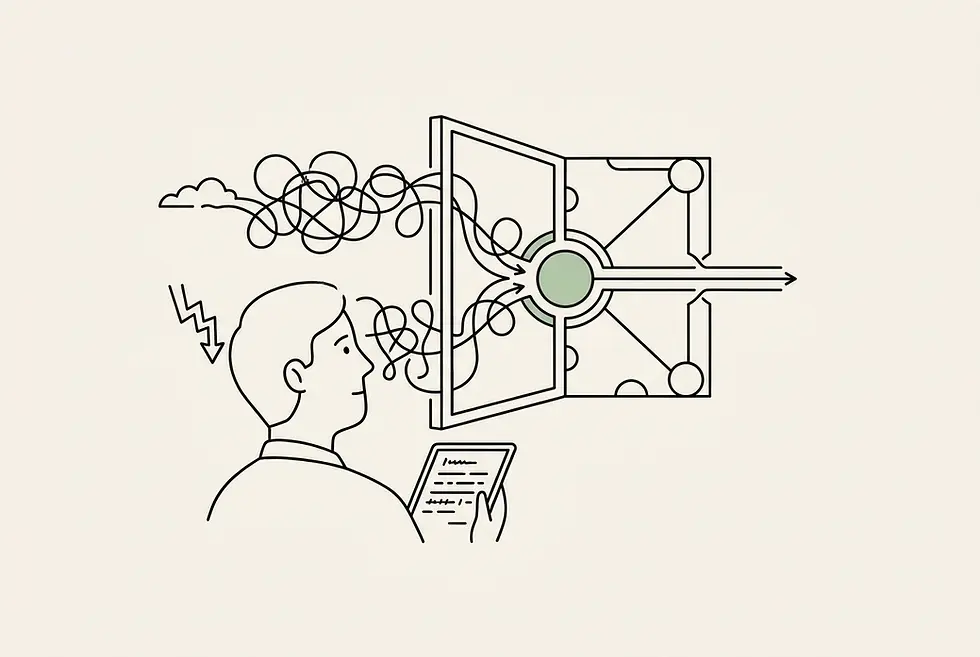
Here is how it works. A single anxious thought, something like "I have to get eight hours or tomorrow is ruined," triggers your body's stress response: cortisol rises, your heart rate climbs, and your muscles tighten. Your nervous system has just received an alarm signal. Sleep requires the opposite state, so the harder your brain pushes, the less likely sleep becomes.
When this happens night after night, your brain learns something unhelpful: bed equals threat. Through a process called conditioned arousal, the bedroom itself becomes a cue for wakefulness rather than rest. You may feel fine on the couch, then notice your mind sharpen the moment you pull back the covers. That is not imagination; it is a learned association your brain has built through repetition.
The cycle deepens because insomnia, anxiety, and depression are bidirectionally linked. Poor sleep amplifies anxious thinking and lowers mood; worsened anxiety and low mood then make sleep harder the following night. Each element feeds the others.
Catastrophizing accelerates this. Thoughts like "I can't function on less than seven hours" are not neutral observations; they raise your physiological arousal before you have even closed your eyes, making the feared outcome more likely, not less.
Perhaps the most counterintuitive part: effortful attempts to force sleep activate the same arousal system keeping you awake. Trying harder genuinely makes things worse, which is exactly why this cycle is so difficult to break on willpower alone.
What Is Cognitive Behavioral Therapy for Insomnia?
So if the cycle is the problem, what breaks it? That's where CBT-I comes in.
Cognitive Behavioural Therapy for Insomnia (CBT-I) is a structured, evidence-based psychological treatment designed specifically to target the thoughts, behaviours, and physiological patterns that keep chronic insomnia going. It is not a refined version of sleep hygiene advice. Where sleep hygiene offers general lifestyle guidance, CBT-I is a clinical intervention with specific, manualized components delivered by a trained therapist. Think of it as addressing the engine of the problem, not just the symptoms.
CBT-I belongs to the broader CBT family, which you may have encountered in the context of anxiety or depression treatment. The core CBT principle that thoughts influence feelings and behaviour applies directly here: it is your beliefs and responses about sleep that sustain the wakefulness cycle, and CBT-I is built to change exactly those patterns.
The clinical evidence behind this approach is strong. The American College of Physicians recommends CBT-I as the first-line treatment for chronic insomnia, ahead of sleep medication, citing superior long-term outcomes and a meaningfully lower relapse risk.
Accessibility is also less of a barrier than many people expect. A meta-analysis of 24 studies found equivalent quality-of-life improvements across both in-person and online delivery formats, with a standardised mean difference of approximately 0.47 across both modes. Wherever you are, effective treatment is reachable.
The Five Core Components of CBT-I (and What Each One Does)
CBT-I combines five distinct techniques, each targeting a different piece of the insomnia puzzle.
Sleep consolidation (sometimes called sleep restriction therapy) is the most counterintuitive component, and often the most powerful. Your sleep window is temporarily compressed, creating genuine sleep pressure that rebuilds your body's drive to sleep.
Stimulus control retrains your brain's association with the bedroom. If you regularly lie awake there anxious, the bed becomes a cue for wakefulness. The fix is straightforward: use the bed only for sleep and intimacy, and if you cannot sleep within roughly 20 minutes, get up and return only when sleepy.
Cognitive restructuring is the heart of CBT-I. You and your therapist examine beliefs like "I need eight perfect hours or tomorrow is ruined," test them against evidence, and replace them with more accurate alternatives. Learning to challenge anxious thinking during moments of high distress applies directly to the pre-sleep spiral.
Sleep hygiene covers habits most people already know: a consistent wake time, limiting caffeine, managing evening light exposure. These matter, but they are supporting scaffolding rather than the main structure.
Relaxation techniques address the physiological side. Progressive muscle relaxation, diaphragmatic breathing, and mindfulness-based practices lower the cortisol and physical tension that keep the body on alert when it should be winding down.
Together, these five components address every layer of the anxiety-insomnia cycle rather than any single symptom.
CBT-I vs. Sleep Medication: What the Evidence Actually Shows
Knowing what CBT-I does is one thing. Understanding why it outperforms the alternatives is what usually moves people to try it.
Reaching for a sleep aid first is completely understandable. It feels practical, it is easy to access, and for a few rough nights it can offer real relief. That is not a failure; it is a reasonable response to exhaustion.
The limitation shows up over time. Sleep medications address the symptom, but they do not touch the conditioned arousal or the anxious thought patterns keeping the cycle going. When the medication stops, those patterns are still there, which is why relapse is common after discontinuation. Clinical guidelines note there is insufficient evidence to recommend pharmacotherapy as a sustained treatment for chronic insomnia.
CBT-I works differently, and the follow-up data reflect that. A meta-analysis of 30 randomized controlled trials measured Insomnia Severity Index scores after treatment ended entirely: Hedges g = 0.64 at three months, g = 0.40 at six months, and g = 0.25 at twelve months. The improvements persist and continue building because the underlying patterns have actually changed, not just been suppressed.
Melatonin deserves a separate note. It is genuinely useful for circadian rhythm disruption, including jet lag or shift-work adjustment. What it does not do is address the cognitive and behavioural patterns driving chronic insomnia. If clock-watching, conditioned arousal, and catastrophic sleep thoughts are the problem, melatonin is working on the wrong mechanism entirely.
CBT-I When Insomnia Comes With Anxiety or Depression
If you are dealing with insomnia, anxiety, and depression all at once, you are not unusual. In clinical practice, this combination is the rule rather than the exception. Most people seeking help for sleep problems are carrying more than one concern, and that reality shapes how good therapy is delivered.
It is worth being honest about what the research shows. CBT-I works best when insomnia stands alone, producing a pooled effect size of 0.59. When insomnia occurs alongside other conditions, that figure drops modestly to 0.48, and to 0.29 when a major disorder like depression is also present. These numbers still represent meaningful, clinically relevant improvement. The picture is not as clean as with standalone insomnia, but it is far from discouraging.
A skilled therapist adapts the approach rather than abandoning it. Sleep consolidation is introduced more gradually to avoid worsening low mood in the early weeks. Cognitive restructuring expands to address both sleep-specific fears and the broader daytime worry that feeds them, since both draw from the same patterns of rumination. The conditions are treated in a coordinated way rather than in isolation.
One of the more encouraging findings is that improving sleep tends to improve everything else too. A large 2024 meta-analysis found a 32% depression response rate among people who received CBT-I, compared to 17% in control conditions. Better sleep creates genuine downstream gains in mood and anxiety.
Having anxiety or depression alongside insomnia does not close the door on CBT-I. It shapes the treatment plan, not the outcome ceiling.
Why CBT-I Is So Rarely Offered (And What You Can Do About It)
So if CBT-I works this well, why hasn't your doctor mentioned it?
The honest answer is that most physicians simply reach for what is fastest and most familiar. There is a genuine shortage of therapists trained to deliver the full CBT-I protocol, and prescribing a sleep aid takes minutes where a referral to a specialist may take weeks. If you were handed a prescription without any mention of therapy, that is not unusual; it reflects a system gap, not a judgment about your situation.
What to look for in a provider matters more than most people realise. You want a therapist with a solid grounding in cognitive behavioral therapy who also understands the insomnia-anxiety relationship specifically, can deliver all five components of the protocol, and has experience adapting the approach when anxiety or depression is also in the picture.
Geography used to be a real obstacle here. It no longer is. A large meta-analysis found that online CBT-I and face-to-face CBT-I produce virtually identical quality-of-life improvements (SMD 0.47 versus 0.46), meaning a qualified therapist anywhere in Ontario is as effective as one down the street.
For readers in Ontario who have felt underserved by a medication-first approach, Jing Counselling offers CBT-based therapy for sleep, anxiety, and depression, with sessions available online across the province and in-person in Markham. Services are offered in both English and Mandarin; you can explore the Mandarin-language therapy options or learn more about what therapy sessions involve before reaching out.
What Does CBT-I Actually Look Like in Practice?
So what does the process actually feel like from week one?
Most clients complete CBT-I in 6 to 8 sessions. Meaningful improvement often shows up within the first few weeks, once sleep consolidation begins rebuilding your body's natural sleep pressure.
A typical session follows a clear rhythm. You and your therapist review your sleep diary from the past week, spotting patterns in when you fell asleep, woke up, and lay awake worrying. From there, you work together to adjust your sleep window and practise cognitive restructuring, identifying the unhelpful thoughts driving your anxiety and replacing them with more realistic alternatives.
One honest heads-up: the early stage can feel uncomfortable. Sleep consolidation temporarily restricts your time in bed, and for the first week or so many clients feel more tired before things improve. This is normal, and it is exactly why working with a therapist matters. Having someone help you interpret what is happening, and stay the course when it feels counterintuitive, makes a significant difference to outcomes.
The deeper value of CBT-I is that it builds skills you keep. Unlike medication, which works only while you take it, CBT-I teaches you to read your own sleep patterns, challenge unhelpful thinking, and use evidence-based tools independently. Research shows benefits persist well beyond treatment, remaining clinically significant at 12-month follow-up.
CBT-I is also no longer just for adults. Recent evidence confirms its effectiveness in adolescents, making it a relevant option for families noticing that a teenager is struggling with sleep and anxiety together.
You Do Not Have to Just Live With It
Chronic insomnia is not a personal failing, and it is not something you simply have to endure. It is a treatable condition driven by anxious thinking patterns, and CBT-I is specifically designed to break that cycle at its root.
The evidence is clear: CBT-I is recommended as a first-line treatment ahead of sleep medication, produces durable improvements that hold up at 12 months, carries no side effects, and works whether you access it online or in person. It is also effective when insomnia arrives alongside anxiety or depression, which is more often the rule than the exception.
If you recognise yourself in any part of what this article has described, whether it is the clock-watching, the dread of another sleepless night, or the sense that trying harder only makes things worse, that recognition is worth acting on. Speaking with a therapist trained in CBT-I is the most evidence-supported step you can take.
At Jing Counselling, CBT-based therapy for sleep, anxiety, and depression is available online across Ontario and in person in Markham, in both English and Mandarin. You can explore available services in Mandarin or reach out in English to find out whether this approach is the right fit for you. Better sleep is not out of reach.
Conclusion
Sleep is not a performance you can force, and insomnia is not a life sentence. The key takeaways from this guide are straightforward: the anxiety-insomnia cycle is driven by thought patterns, not just poor habits; CBT-I breaks that cycle at its source rather than masking symptoms; it outperforms sleep medication in long-term outcomes; and it works even when anxiety or depression are part of the picture.
You do not need to white-knuckle your way through another restless night or resign yourself to relying on medication indefinitely. CBT-I offers a structured, evidence-based path toward sleep that actually lasts.
If any part of this article reflected your experience, that is your starting point. At Jing Counselling, CBT-based support for insomnia, anxiety, and depression is available online across Ontario and in person in Markham. Reach out today. Genuine, lasting rest is closer than it feels.
Frequently Asked Questions
What is CBT-I and how is it different from regular sleep advice?
CBT-I (Cognitive Behavioral Therapy for Insomnia) is a structured, evidence-based psychological treatment that targets the anxious thought patterns and behaviors keeping you awake, not just environmental factors. While sleep hygiene tips address your bedroom environment and habits, CBT-I addresses the underlying thinking problem—the cycle of dread, fear, and worry that prevents sleep. It's recommended by major medical organizations like the American College of Physicians as the first-line treatment for chronic insomnia, ahead of sleep medication.
How long does CBT-I treatment typically take, and when will I see results?
Most clients complete CBT-I in 6 to 8 sessions. Meaningful improvement often appears within the first few weeks once sleep consolidation begins rebuilding your body's natural sleep pressure. While the early stage can feel uncomfortable (you may feel more tired initially), this is normal and temporary. Working with a trained therapist helps you interpret what's happening and stay the course through this adjustment period.
Does CBT-I work if I also have anxiety or depression?
Yes. While CBT-I works best when insomnia stands alone, it remains effective when combined with anxiety or depression. Research shows a 32% depression response rate among people who received CBT-I compared to 17% in control conditions. A skilled therapist adapts the approach by introducing sleep consolidation gradually, expanding cognitive restructuring to address both sleep-specific fears and broader worry patterns, and treating the conditions in a coordinated way. Better sleep often improves everything else too.
How does CBT-I compare to sleep medication in terms of long-term results?
CBT-I significantly outperforms sleep medication for long-term outcomes. While medications address symptoms temporarily, they don't change the underlying anxious thought patterns or conditioned arousal keeping insomnia going. Clinical data shows that after CBT-I treatment ends, improvements persist and continue building at 3, 6, and 12-month follow-ups. In contrast, when sleep medication is stopped, the original patterns return, leading to common relapse. This is why major medical guidelines recommend CBT-I first, ahead of pharmacotherapy.
Can I access CBT-I online, or do I need to see a therapist in person?
Both are effective. Research shows that online CBT-I and face-to-face CBT-I produce virtually identical quality-of-life improvements. A meta-analysis of 24 studies found no meaningful difference between delivery formats, making geography no longer a barrier to treatment. You can access qualified CBT-I therapy online from anywhere, which is particularly valuable if trained therapists are unavailable in your area or if in-person sessions are inconvenient.


Comments